Share
From fiction to action
The future does not have to be invented from scratch. It is already here, in fragments. We still have to be able to read them.
Last summer, on holiday, I started working on version 2 of Le capteur de possibles (roughly, “the catcher of possibles”), the tool I simply call the Capteur. Feedback from the first users was clear: an idea does not become actionable because it is appealing. You need to understand what it rests on, what it shifts and what it needs beside it to hold.
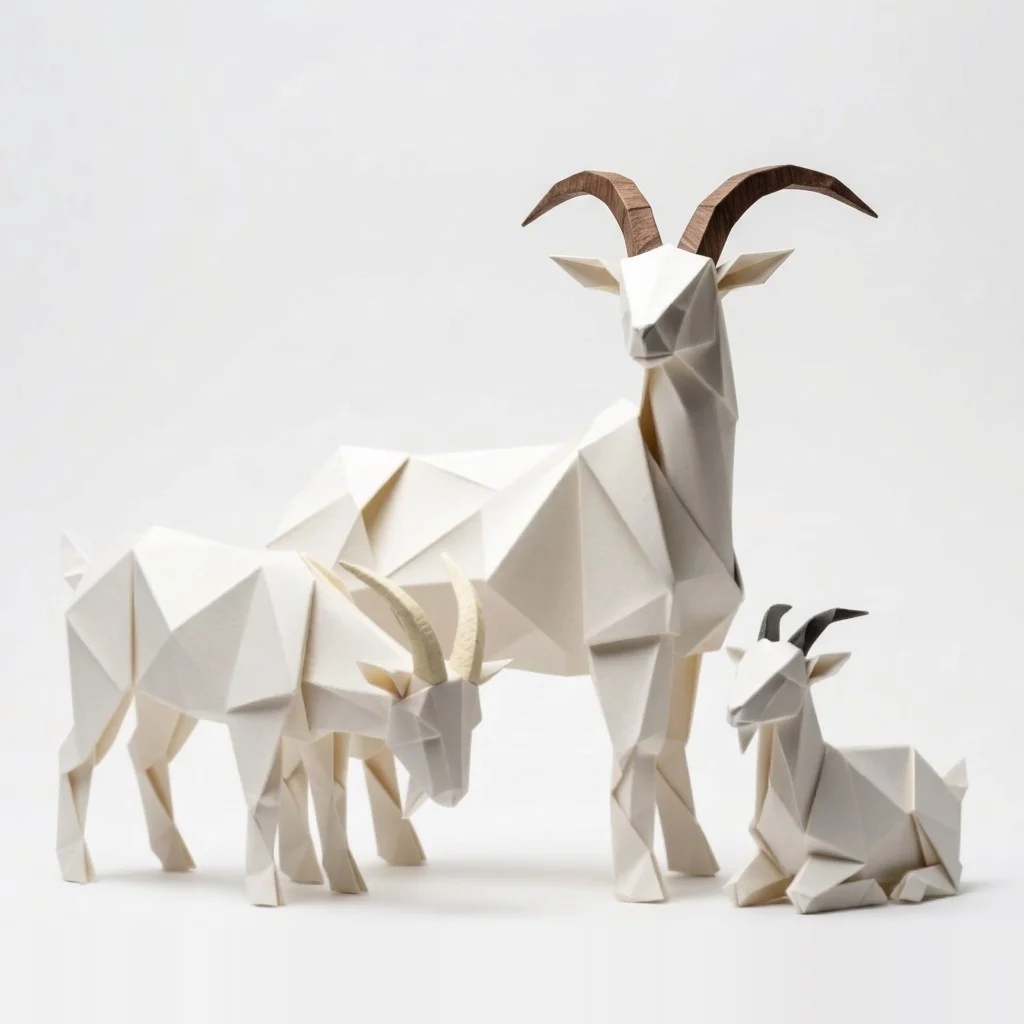
Around that time, my nephew told me he had bought three goats rather than a ride-on mower. They keep his land tidy. But they also do something else: his daughters watch them, name them, grow attached to them. A technical function, mowing, now comes with a relationship.
The story could seem trivial. Yet it stopped me in my tracks, because I see local or personal initiatives of this kind emerging everywhere: ways of doing things that answer a concrete problem but often remain exceptions, curiosities or isolated good ideas.
Fragments already here
I think of the wildlife corridors that let squirrels, and many other species, cross the barriers created by roads and cities. I think of the hectares burnt every summer, the habitats destroyed, the animals that disappear with them, and the species whose living conditions decline without always showing up on our dashboards.
We know how to see damage once it is there. We see far less easily the relationships that produce it: an infrastructure, a land use, an economic arrangement, a decision taken elsewhere, then a chain of consequences that seem to have nothing to do with one another.
There is no shortage of precedents. What we lack is the ability to understand how to hold these fragments together.
That is what I wanted to test with the goats. Not to prove that three goats could replace a mower everywhere, but to see what this hypothesis made visible.
What the Capteur reveals
Working from this case, the Capteur opened pathways and surfaced precedents I would never have looked for on my own. It was no longer only about tending a piece of land differently. The question became: how does a decision take into account what is alive, what has no direct voice, what depends on us without being able to sit at the table?
Wales offers a first precedent. Since the Well-being of Future Generations Act of 2015, Welsh public bodies must build long-term thinking into their decisions and pursue social, cultural, environmental and economic well-being goals. The Act also creates the independent office of Future Generations Commissioner.
The Commissioner’s role is to promote sustainable development, encourage public bodies to consider the long-term effects of their decisions, monitor their goals and make recommendations. The office can carry out formal reviews and help institutions improve the way they act, without being able to overturn a decision already taken.
In New Zealand, the Whanganui River became a legal person in 2017. This recognition does not mean that the river “speaks” in a literal sense: it gives the river a legal existence of its own and organises its representation. Two guardians, one appointed by the Māori iwi and the other by the Crown, form Te Pou Tupua, its human face in administrative and legal matters.
Wales gives future generations an institutional place. New Zealand gives a river legal representation. These experiments are not models to import as they are. They do show, however, that interests absent from the immediate decision can be institutionalised.
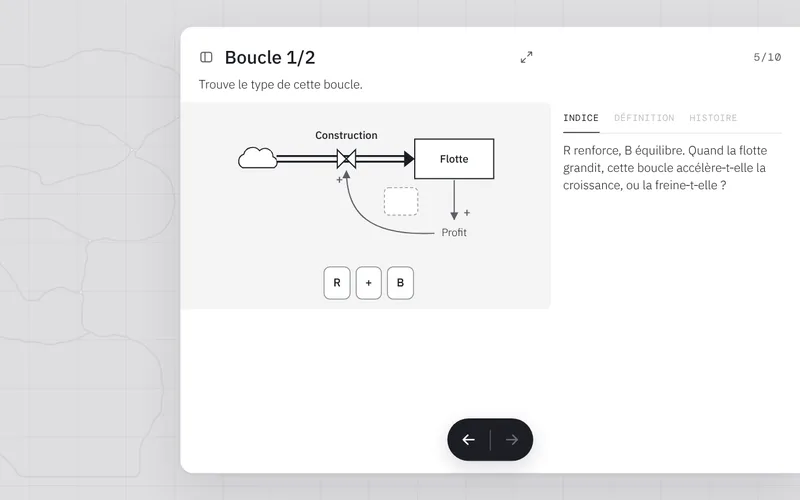
This is the “what if” the demo plays out from start to finish: public institutions that would have wildlife, plants and ecosystems represented in their decisions. See the game.
Institutionalising in every sense
This is where the idea becomes important: we need to institutionalise in every sense of the word.
Institutionalising is not only about creating a law, a post or a procedure. It means making a question lasting enough that it does not depend solely on the goodwill of one person, one team or one political moment. It means giving it rules, responsibilities, resources, spaces for discussion and the weight to influence decisions.
But institutionalising also means accepting that our institutions represent more than the interests already sitting at the table. Future generations, ecosystems, rivers, species and the interdependencies of a territory do not have the same standing as a company, a voter or a budget. Yet they bear the consequences of decisions and determine whether those decisions can last.
The goats then become less trivial. They do not only raise the question of how to tend a piece of land. They force us to look at the relationships between the soil, the animal, the residents, working practices, health regulations, costs, uses, and the forms of attention we want to create.
Greece as a counterpoint
While I was finishing version 2 of the Capteur, a report on Greece shifted this line of thought. Faced with drought and pressure on Athens’ water supply, the authorities considered partially diverting two rivers in Evrytania, the Krikeliotis and the Karpenisiotis, towards the Evinos reservoir that supplies Attica.
At the same time, reducing leaks in an ageing network would save around 58 million cubic metres of water a year, the annual consumption of a city of 600,000 people, according to the Greek deputy minister quoted by Ta Nea (article in Greek).
This is not about setting a concrete emergency against a position of principle. Athens faces a real risk of shortage. But the contrast deserves a closer look: on one side, water and its ecological consequences are moved onto other territories; on the other, part of the water is already being lost through a worn-out network.
This is where the link with the Whanganui becomes useful. If the rivers concerned were represented in the decision, what questions would their representatives ask? What would be said about their flow, their ecosystems, the villages that depend on them, the cumulative effects of abstraction, and what should be restored rather than diverted?
The question is no longer only: “How do we supply Athens?” It becomes: “What must we transform so that Athens’ water supply does not rest, over time, on weakening other ecosystems?”
Fiction as a reading tool
This is where fiction becomes useful. It replaces neither data, nor calculations, nor investigation. It gives a temporary shape to what remains scattered.
We expect a decision that commits an organisation to be solid and measured, grounded in analysis and facts. We expect far less that a piece of fiction might help prepare it. Yet telling the story of a situation that does not exist yet can help us understand what it would take for it to exist.
George Orwell did not invent dictatorship. John Brunner did not invent pollution. They took phenomena that were already visible and pushed them far enough to reveal their nature, before it became impossible to ignore.
In Nineteen Eighty-Four, the subject is not only authoritarian power. It is also a language that reduces, word by word, the possibility of thinking otherwise. In The Sheep Look Up, disaster does not fall from the sky: it grows out of ecological, health, economic and political crises that end up contaminating one another.
Darko Suvin calls the novum the new element that transforms the world of a story and lets us see our own differently. Fiction does not flee reality. It can make visible the relationships, dependencies and consequences we have grown used to looking at separately.
Starting from a “what if”
So the Capteur starts with a “what if”.
What if three goats tended a town’s verges? At this stage, we do not have a solution. We have a hypothesis to test. Which plots would be involved? Who would look after the animals? How would they be moved? What would happen in the event of drought, illness, absence or accident?
This fiction could take the form of a schedule, an agreement between a town council and a farmer, a job description or a meeting between the departments involved. These imaginary objects do not replace reality: they prepare for it. They make responsibilities, needs, conflicts and blind spots visible.
The isolated idea then becomes a question about a system. The goats stop being a pleasant image. They become a way of asking: which activities do they really replace? What new work do they create? For whom? Under what constraints? And what do they change in the way we regard the living world?
Coming back to measurement
Going through fiction does not mean deciding on the basis of a story. The risk is real: building a coherent, appealing narrative and ending up mistaking it for proof.
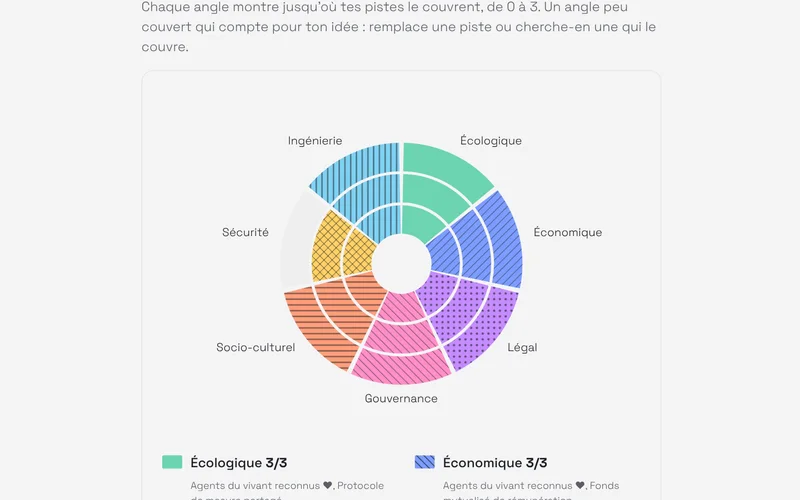
That is why fiction, in Novum, comes back to measurement. Grounding looks for what a hypothesis can already rest on: existing practices, precedents, resources, actors or identifiable mechanisms. It also looks for the gaps between what exists and what would need to be built.
Spread examines what would happen if the idea took hold more widely. What would have to be reproduced or adapted? What infrastructure would be needed? What dependencies would this spread create? Would what works at a small scale remain fair, desirable and viable elsewhere?
These dimensions are not proof of feasibility. They organise the inquiry. They help distinguish what is documented from what is still assumed, what can be attempted from what must be transformed, and what deserves to be abandoned.
Fiction opens. Measurement tests.
What version 3 is looking for
While working on version 3, one conviction became clearer: many pathways already exist. People, collectives, towns and institutions are trying to change the rules of the game, here and elsewhere.
They do not always have the financial means, the visibility or the reach of large companies. Their problem is not necessarily a lack of ideas. It is often a lack of connections: with comparable precedents, complementary resources, institutions able to support them, and stories that make their significance understandable.
Not everything can be connected simply. But we need to rebuild the connections that matter: between a local initiative and the systems it questions; between the interests present and those that cannot defend themselves; between a visible emergency and its less visible causes.
This capacity for reading is what I want to stand up for with the Capteur. It does not claim to predict the future or to pick a dominant option. It helps make a hypothesis legible, find what already exists, see what it shifts, and organise a fairer discussion about what should be done.
Telling the impossible from the illegible
The next time an idea is declared “not realistic”, try asking this simple question: what, exactly, does not hold?
The answer may reveal a real impossibility, a serious risk, an undesirable consequence or an unacceptable dependency. But it may also show that we cannot yet see how the pieces could fit together.
In that case, the point is not to defend an idea at all costs. It is to give it a story precise enough to make its conditions open to debate, and then to test that story against reality.
The future does not have to be invented from scratch. It is already here, in fragments. We still have to be able to read them.
The precedents in the game
In the demo game, the Capteur opened seven pathways around this “what if”. Here are the precedents kept and checked online, pathway by pathway. They are not proof that the idea will work: they are fragments already here that it can build on.
Institutional delegates of the living world (the lead card)
- Te Awa Tupua, the legal personhood of the Whanganui River, New Zealand, 2017
- The rights of nature in Ecuador’s Constitution (in French), Ecuador, 2008
- The Parliament of the Loire (in French), France, process launched in 2019
Citizens’ assembly of the living world
- The committee of representatives of the Mar Menor guardianship (in French), Spain, 2022 law, set up in 2025
- The Welsh Youth Parliament, Wales, since 2018
Legal status for the non-human living world
- The Law of the Rights of Mother Earth (in French), Bolivia, 2010
Shared eco-risk fund
- The MAIF Fund for the Living World (in French), France, since 2023
Hands-on field workshops
- River classes (in French), France, notably in Brittany
International network of living labs
- The Long Term Ecological Research network (LTER), United States, since 1980
- The CNRS Zones Ateliers network (in French), France, since the 1990s
- The Global Alliance for the Rights of Nature, international, since 2010
The full list, with the precedents set aside and the reason for each choice, is in the demo.